How to Trade New & Low-Liquidity Tokens More Safely on Solana
Esta página aún no está disponible en tu idioma.
New token launches are some of the most exciting—and most dangerous—moments in crypto.
A token can rise 500% within minutes.
It can also lose 95% just as quickly.
For many traders, success during a launch isn’t determined by being first. It’s determined by making fewer mistakes.
Professional traders understand that the biggest risks often aren’t market direction—they’re execution quality, fake tokens, poor liquidity, and avoidable trading errors.
This guide explains how experienced traders approach new token launches on Solana and what you should check before every trade.
Why New Token Launches Are Different
Section titled “Why New Token Launches Are Different”Trading SOL or USDC is very different from trading a token that launched five minutes ago.
Established tokens usually have:
- deep liquidity
- active market makers
- multiple trading venues
- relatively stable pricing
New launches often have:
- one or two liquidity pools
- rapidly changing prices
- very limited liquidity
- significant volatility
- intense competition
This changes how you should approach execution.
The objective isn’t simply to buy as fast as possible.
It’s to buy safely while understanding the risks involved.
The Biggest Risks During Token Launches
Section titled “The Biggest Risks During Token Launches”Most traders focus entirely on price.
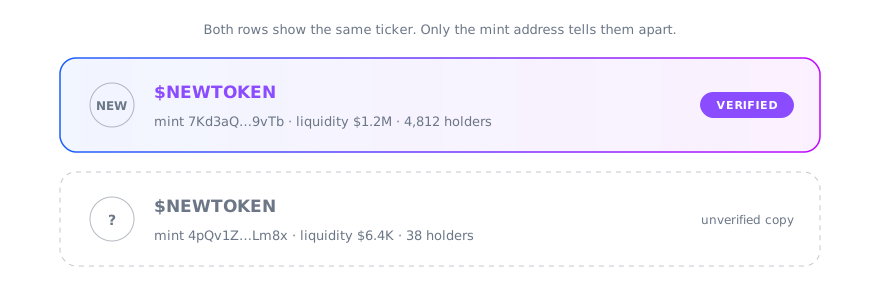
Experienced traders evaluate several different risks simultaneously.
Fake Tokens
Section titled “Fake Tokens”One of the oldest scams in crypto remains surprisingly effective.
A malicious actor creates a token using the same:
- name
- ticker
- logo
as a popular project.
The token appears legitimate.
The contract isn’t.
Before buying any newly launched token, always verify the token address using official project channels rather than relying solely on the token name.
Thin Liquidity
Section titled “Thin Liquidity”Liquidity determines how easily assets can be bought and sold.
A token might show a market capitalization of several million dollars while having only a small amount of actual trading liquidity.
This creates two problems.
Entering becomes expensive.
Exiting becomes even more expensive.
Large price movements can occur simply because one trader places a moderate-sized order.
Extreme Price Impact
Section titled “Extreme Price Impact”Price impact is often underestimated during launches.
Suppose a pool contains only $40,000 worth of liquidity.
A $10,000 purchase immediately consumes a significant portion of available depth.
The buyer ends up paying progressively higher prices throughout execution.
The displayed quote and the actual execution may differ substantially.
High Volatility
Section titled “High Volatility”New markets are still discovering fair value.
Prices can move dramatically within seconds.
A token trading at:
$0.05
may trade at:
$0.08
or
$0.02
before your transaction is even confirmed.
Volatility isn’t necessarily a warning sign.
It’s simply part of price discovery.
Understanding that helps traders set realistic expectations.
Why Speed Isn’t Everything
Section titled “Why Speed Isn’t Everything”Crypto social media often celebrates whoever buys first.
Professional traders know that speed alone rarely guarantees the best outcome.
Imagine two participants entering the same launch.
Trader A submits the first available transaction without reviewing execution details.
Trader B spends an additional fifteen seconds checking:
- liquidity
- routing
- price impact
- token verification
Trader B might enter slightly later.
Yet they often achieve a significantly better execution.
In volatile markets, thoughtful execution frequently beats blind speed.
Understanding Liquidity Before You Buy
Section titled “Understanding Liquidity Before You Buy”Liquidity is one of the most important metrics during any launch.
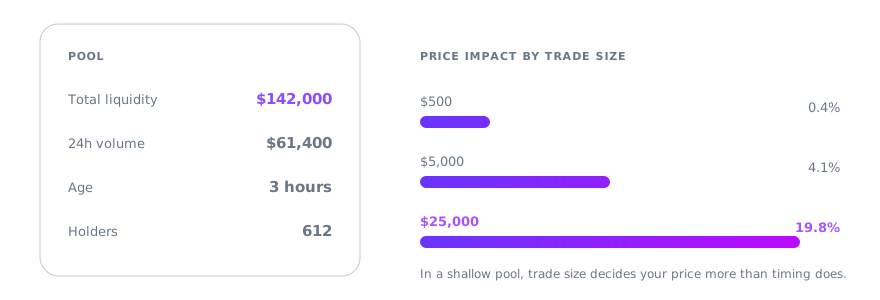
Ask yourself:
How much capital exists in the available pools?
How many venues list the token?
Is liquidity concentrated in one pool or spread across multiple sources?
Can a moderately sized trade move the price significantly?
These questions often matter more than market capitalization during the first hours of trading.
Why Large Orders Should Be Split
Section titled “Why Large Orders Should Be Split”New traders often execute their entire position at once.
Professional traders frequently don’t.
Suppose you intend to purchase $20,000 of a newly launched token.
Buying everything immediately might create significant price impact.
Instead, experienced traders may:
- divide the position
- monitor liquidity development
- average into the trade
- reassess execution after each purchase
This approach doesn’t guarantee better returns.
It simply reduces unnecessary execution risk.
Using Slippage Carefully
Section titled “Using Slippage Carefully”High slippage settings are common during token launches.
However, they should be used deliberately.
Higher slippage increases the probability that your transaction executes.
It also increases the range of prices you’re willing to accept.
Some traders simply maximize slippage hoping to “guarantee” execution.
That can produce extremely poor fills during volatile conditions.
Instead, think of slippage as a risk management tool rather than a speed setting.
Why Routing Matters More During Launches
Section titled “Why Routing Matters More During Launches”Liquidity is becoming increasingly fragmented across the Solana ecosystem.
A new token may exist on multiple decentralized exchanges simultaneously.
Each venue can have:
- different liquidity
- different fees
- different pricing
Manually comparing these opportunities is nearly impossible while markets are moving.
This is where routing infrastructure becomes particularly valuable.
Rather than forcing an order through one liquidity pool, an aggregator can evaluate multiple execution paths before submitting the transaction.
The goal isn’t to eliminate risk.
It’s to make better use of available liquidity.
A Practical Launch Checklist
Section titled “A Practical Launch Checklist”Before swapping into any newly launched token, experienced traders usually work through a simple checklist.
✓ Verify the Token
Section titled “✓ Verify the Token”Confirm the contract address using the project’s official website or social channels.
Never rely solely on the token name.
✓ Check Liquidity
Section titled “✓ Check Liquidity”How much liquidity exists?
Very shallow pools generally carry higher execution risk.
✓ Review Price Impact
Section titled “✓ Review Price Impact”Large price impact often indicates insufficient liquidity for your intended trade size.
✓ Understand Slippage
Section titled “✓ Understand Slippage”Choose a tolerance appropriate for current market conditions rather than simply selecting the highest available value.
✓ Review the Route
Section titled “✓ Review the Route”If multiple liquidity sources exist, understand how your trade will execute before confirming.
✓ Avoid Emotional Decisions
Section titled “✓ Avoid Emotional Decisions”Fear of missing out causes more trading mistakes than almost anything else.
Missing one opportunity is usually preferable to entering the wrong trade.
Common Mistakes New Traders Make
Section titled “Common Mistakes New Traders Make”Buying Because Everyone Else Is
Section titled “Buying Because Everyone Else Is”Social momentum is not due diligence.
Always understand what you’re buying before executing a trade.
Ignoring Liquidity
Section titled “Ignoring Liquidity”Price charts can look attractive even when liquidity is dangerously low.
Always consider whether you’ll eventually be able to exit your position.
Trading Too Large
Section titled “Trading Too Large”Your position size should reflect market liquidity.
Large orders can dramatically worsen execution.
Skipping Verification
Section titled “Skipping Verification”Many scams succeed because traders only verify the ticker symbol rather than the contract address.
Treating Every Launch the Same
Section titled “Treating Every Launch the Same”Every token launches under different conditions.
Liquidity, volatility, routing options and market participation all vary.
Good traders adapt their strategy accordingly.
How Swap.io Supports Better Execution
Section titled “How Swap.io Supports Better Execution”Swap.io is designed to help traders navigate fragmented liquidity rather than forcing them to choose a single trading venue.
When supported liquidity exists across multiple Solana protocols, Swap.io evaluates available execution paths before submitting the transaction.
This helps traders:
- compare execution routes
- understand expected outputs
- reduce unnecessary price impact
- simplify access to fragmented liquidity
The platform doesn’t remove the inherent risks of new token launches.
Instead, it provides better execution tools so traders can make more informed decisions before approving a swap.
- Verify the token contract.
- Review liquidity depth.
- Check expected price impact.
- Set an appropriate slippage tolerance.
- Review the execution route.
- Only trade an amount appropriate for the available liquidity.
Key Takeaways
Section titled “Key Takeaways”- New token launches behave very differently from established markets.
- Fake tokens remain one of the most common mistakes during launches.
- Liquidity matters more than market capitalization in the earliest stages of trading.
- Large orders can dramatically increase price impact.
- Speed alone does not guarantee good execution.
- Smart routing becomes increasingly valuable as liquidity fragments across multiple venues.
- Professional traders focus on execution quality rather than simply being first.
Frequently Asked Questions
Section titled “Frequently Asked Questions”How do I know if a new token is legitimate?
Always verify the contract address through the project’s official website, documentation, or verified social media accounts before making a purchase.
Why is liquidity so important?
Liquidity determines how efficiently you can buy and sell a token. Low liquidity generally results in higher price impact, wider spreads, and greater execution risk.
Should I use high slippage for new token launches?
Sometimes higher slippage is necessary because prices move rapidly. However, unnecessarily high settings may result in significantly worse execution prices.
Is it safer to split large orders?
Often, yes. Splitting a large order can reduce price impact and give traders an opportunity to reassess market conditions between executions, although every situation is different.
Can a DEX aggregator eliminate launch risk?
No. Volatility, liquidity changes, and market risk remain part of trading newly launched assets. A DEX aggregator can improve route selection and execution quality, but it cannot eliminate the underlying risks of decentralized markets.
What should I check before every new token swap?
At a minimum: