How to Swap Tokens on Solana (Step-by-Step Guide)
Это содержимое пока не доступно на вашем языке.
Swapping tokens is one of the most common activities in the Solana ecosystem.
Whether you’re buying your first memecoin, moving into stablecoins, or rebalancing a DeFi portfolio, the process is straightforward—but there are a few important concepts that can save you money and prevent costly mistakes.
Many beginners assume every decentralized exchange offers the same price.
They don’t.
The route your transaction takes, the available liquidity, and current market conditions all influence how many tokens you ultimately receive.
This guide walks through the complete process while explaining what actually happens behind the scenes.
Before You Start
Section titled “Before You Start”Before making your first swap you’ll need three things.
A Solana Wallet
Section titled “A Solana Wallet”Install a supported wallet such as Phantom, Solflare or another compatible Solana wallet.
Your wallet stores your assets and signs every transaction.
Unlike centralized exchanges, your funds always remain under your control.
Some SOL for Network Fees
Section titled “Some SOL for Network Fees”Every transaction on Solana requires a very small amount of SOL.
Network fees are usually only a fraction of a cent, but your wallet still needs enough SOL to pay them.
Without SOL, transactions cannot be processed.
Tokens to Swap
Section titled “Tokens to Swap”Make sure the token you want to sell is already in your wallet.
If you’re purchasing a newly launched token, always verify the official token address before trading.
Step 1 — Connect Your Wallet
Section titled “Step 1 — Connect Your Wallet”Open a trusted Solana trading interface such as Swap.io.
Click Connect Wallet and approve the connection inside your wallet.
This connection only allows the application to view your balances and request transaction approvals.
It does not give the application custody of your assets.
Step 2 — Choose the Tokens
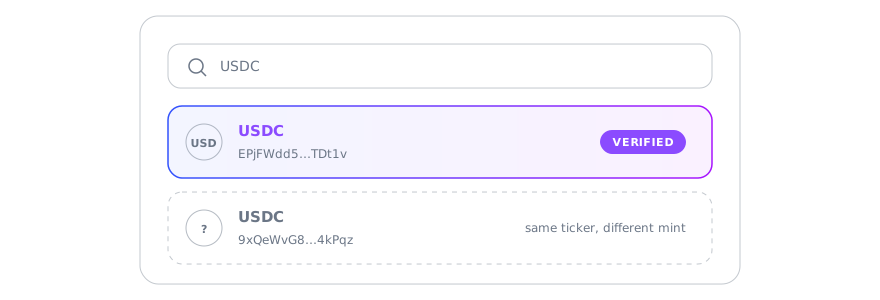
Section titled “Step 2 — Choose the Tokens”Select:
- the token you want to sell
- the token you want to receive
- the amount you want to swap
The platform will immediately calculate an estimated output based on current market conditions.
This quote changes continuously as liquidity updates across the network.
Step 3 — Review the Trade Carefully
Section titled “Step 3 — Review the Trade Carefully”This is the step many beginners rush through.
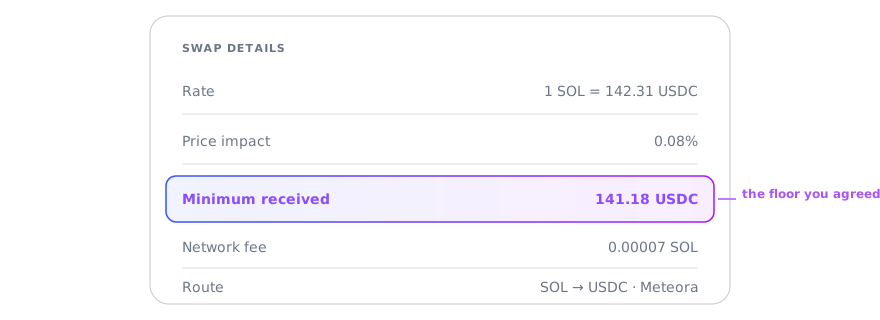
Instead of looking only at the quoted price, review:
- expected amount received
- minimum amount received
- estimated price impact
- network fee
- routing path (if available)
Professional traders spend far more time reviewing execution than clicking “Swap.”
Step 4 — Approve the Transaction
Section titled “Step 4 — Approve the Transaction”If everything looks correct, approve the transaction inside your wallet.
Your wallet signs the transaction locally.
Your private keys never leave your device.
The signed transaction is then broadcast to the Solana network.
Step 5 — Receive Your Tokens
Section titled “Step 5 — Receive Your Tokens”Once the transaction confirms, your new tokens appear in your wallet.
If the token isn’t visible immediately, you may simply need to refresh your wallet or manually enable the asset.
The blockchain transaction itself has already completed.
What Happens Behind the Scenes?
Section titled “What Happens Behind the Scenes?”Although swapping looks simple, several systems work together before your transaction executes.
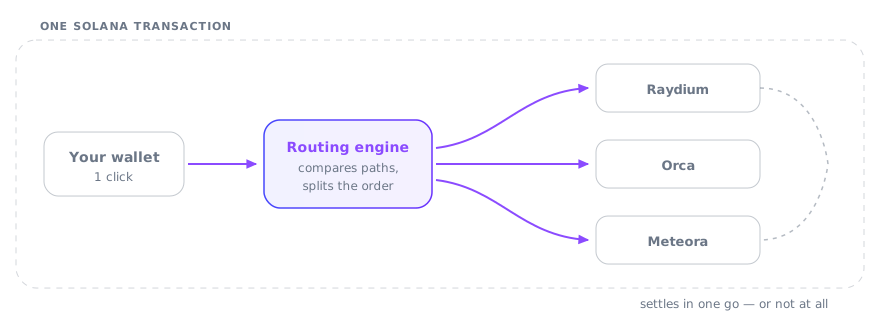
The platform:
- checks available liquidity
- compares possible routes
- estimates price impact
- calculates expected output
- prepares the transaction
On modern aggregators, this process happens in milliseconds.
Instead of manually checking multiple decentralized exchanges, routing software evaluates the available execution paths automatically.
Why Two Users Can Receive Different Prices
Section titled “Why Two Users Can Receive Different Prices”Suppose two users both swap SOL for the same token.
One receives noticeably more tokens.
Why?
Common reasons include:
- different trade sizes
- different liquidity conditions
- different routing
- changing market prices
- different slippage settings
Execution quality—not just token price—determines the final outcome.
Common Mistakes Beginners Make
Section titled “Common Mistakes Beginners Make”Trading the Wrong Token
Section titled “Trading the Wrong Token”Many scam tokens copy legitimate names and symbols.
Always verify the token address before swapping.
Ignoring Price Impact
Section titled “Ignoring Price Impact”Large trades into shallow liquidity pools can produce significantly worse prices than expected.
Review the estimated price impact before confirming.
Setting Unrealistic Slippage
Section titled “Setting Unrealistic Slippage”Very low slippage may cause transactions to fail during volatile markets.
Very high slippage increases execution risk.
Choose settings appropriate for market conditions.
Forgetting About SOL Fees
Section titled “Forgetting About SOL Fees”Always leave a small amount of SOL in your wallet.
Otherwise future transactions may fail even if you own other assets.
Why Many Traders Use Aggregators
Section titled “Why Many Traders Use Aggregators”Liquidity on Solana is distributed across multiple protocols.
Instead of checking each venue individually, aggregators evaluate multiple liquidity sources before executing a trade.
Depending on market conditions, they may:
- use a direct route
- split an order across several pools
- choose a multi-hop route
- avoid pools with excessive price impact
This helps traders access competitive execution without manually comparing every available option.
Where Swap.io Fits
Section titled “Where Swap.io Fits”Swap.io provides a simple interface for swapping tokens across the Solana ecosystem.
Rather than relying on a single liquidity source, it evaluates available routing options before execution, helping users access competitive pricing while keeping the trading process straightforward.
Users remain in control of their wallets throughout the transaction, while the routing engine works behind the scenes to identify efficient execution paths based on current market conditions.
Ready to Make Your First Swap?
Section titled “Ready to Make Your First Swap?”Swapping tokens on Solana is remarkably simple once you understand the basics.
The process only takes a few clicks, but spending an extra minute reviewing execution details can make a meaningful difference to your results.
Good traders don’t simply execute quickly.
They execute well.
Understanding routing, liquidity and price impact will help you make better trading decisions long after your first swap.
You only need a compatible Solana wallet.
Decentralized exchanges are permissionless and do not require registration.
Key Takeaways
Section titled “Key Takeaways”- Swapping tokens on Solana only requires a compatible wallet and a small amount of SOL for network fees.
- Always review execution details before confirming a trade.
- Liquidity and routing influence how many tokens you ultimately receive.
- Verify token addresses before buying newly launched assets.
- Aggregators simplify execution by evaluating multiple liquidity sources automatically.
- Execution quality matters more than simply completing the transaction quickly.
Frequently Asked Questions
Section titled “Frequently Asked Questions”How long does a Solana swap take?
Most swaps are confirmed within a few seconds, although timing depends on current network conditions.
Do I need an account?
No.
What fees will I pay?
You’ll pay Solana network fees and any applicable liquidity provider or protocol fees associated with the selected trading route.
Is swapping on Solana safe?
Using reputable wallets and trusted trading interfaces is generally considered safe, but users should always verify token addresses, review transaction details and understand the risks of decentralized trading.
Why didn't I receive the exact quoted amount?
The quoted amount is an estimate. Final execution depends on liquidity, routing, market movement and price impact at the moment your transaction is processed.
Should I use a DEX or an aggregator?
If you’re swapping tokens, an aggregator can simplify the process by evaluating multiple liquidity sources automatically instead of relying on a single trading venue.