DEX vs Aggregator vs Bridge vs CEX: Which Tool Should You Actually Use?
One of the biggest misconceptions in crypto is that every platform does the same thing.
A new user might ask:
Should I use Binance, Jupiter, Raydium or a bridge?
The answer is usually:
They’re solving completely different problems.
Comparing a bridge with a decentralized exchange is a little like comparing an airport with a taxi.
Both help you get somewhere—but they operate at different stages of the journey.
Understanding these differences makes navigating crypto significantly easier and helps you choose the right tool instead of adding unnecessary steps to every transaction.
The Four Building Blocks of Crypto
Section titled “The Four Building Blocks of Crypto”Most on-chain activity involves one or more of these tools:
- Centralized Exchanges (CEXs)
- Decentralized Exchanges (DEXs)
- DEX Aggregators
- Bridges
They often work together rather than competing with one another.
Let’s look at each individually.
What Is a Centralized Exchange (CEX)?
Section titled “What Is a Centralized Exchange (CEX)?”A centralized exchange is a company that manages trading on behalf of its users.
Examples include:
- Binance
- Coinbase
- Kraken
- OKX
- Bybit
When using a centralized exchange, you deposit your crypto into an account controlled by the platform.
The exchange maintains custody of your assets until you withdraw them.
This approach offers several advantages.
Most centralized exchanges provide:
- fiat deposits
- debit and credit card purchases
- customer support
- advanced trading features
- familiar account-based interfaces
For many people, a centralized exchange is their first step into crypto.
However, convenience comes with trade-offs.
Because the platform controls your assets, you rely on it for custody, withdrawals and account security.
What Is a Decentralized Exchange (DEX)?
Section titled “What Is a Decentralized Exchange (DEX)?”A decentralized exchange allows users to trade directly from their own wallet.
There is no account.
No deposit.
No intermediary holding funds.
Instead, trades are executed through smart contracts using on-chain liquidity.
You remain in control of your assets throughout the transaction.
Examples include:
- Raydium
- Orca
- Meteora
- Phoenix
- OpenBook
Rather than matching buyers and sellers through one centralized system, DEXs access liquidity pools or decentralized order books.
This enables permissionless trading while preserving self-custody.
What Is a DEX Aggregator?
Section titled “What Is a DEX Aggregator?”A DEX aggregator is one level above a decentralized exchange.
It typically doesn’t create liquidity itself.
Instead, it searches across multiple decentralized exchanges to determine an efficient execution path.
Rather than asking:
Which DEX should I use?
An aggregator asks:
Which combination of liquidity sources provides the best execution?
Depending on market conditions, that may involve:
- selecting one DEX
- splitting the order
- using multiple liquidity pools
- executing multi-hop routes
The goal isn’t simply convenience.
It’s improving execution quality.
Examples include:
- Jupiter
- Swap.io
- Other Solana routing platforms
What Is a Bridge?
Section titled “What Is a Bridge?”Bridges solve a completely different problem.
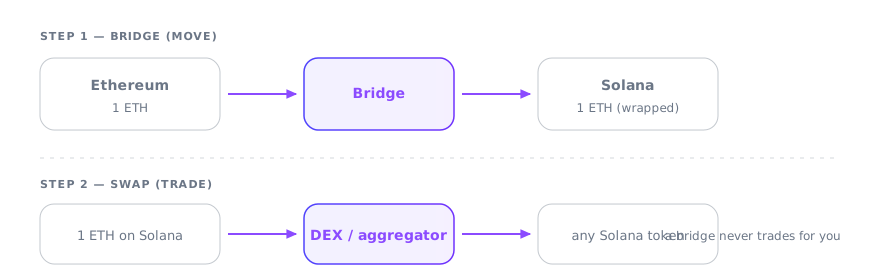
They don’t exchange assets.
They move assets between blockchains.
For example:
Ethereum → Solana
Base → Solana
Arbitrum → Solana
Imagine you own ETH on Ethereum.
A Solana DEX cannot trade that ETH because it exists on a different blockchain.
You first need to move your assets onto Solana.
That’s where bridges become essential.
Once the assets arrive on Solana, you can then use a DEX or aggregator to swap them.
Understanding the User Journey
Section titled “Understanding the User Journey”Many crypto transactions involve several tools working together.
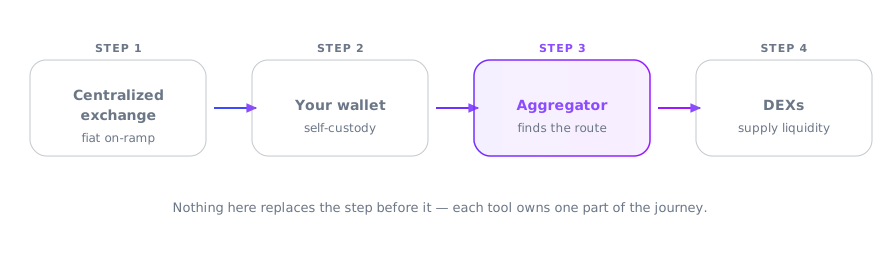
For example:
You buy SOL on Coinbase.
You withdraw it to Phantom.
You swap SOL into another token using Swap.io.
Each platform played a different role.
The centralized exchange provided fiat access.
The wallet stored your assets.
The aggregator optimized execution.
The underlying DEXs supplied liquidity.
None replaced the others.
Each solved a separate problem.
Comparing the Four
Section titled “Comparing the Four”| Feature | CEX | DEX | Aggregator | Bridge |
|---|---|---|---|---|
| Primary purpose | Buy, sell and custody crypto | Trade on-chain | Find better execution | Move assets between chains |
| Custody | Platform | User | User | User |
| Requires account | Yes | No | No | No |
| Uses smart contracts | Limited | Yes | Yes | Yes |
| Trades assets | Yes | Yes | Yes | No |
| Moves assets across chains | No | No | No | Yes |
| Optimizes routing | No | Limited | Yes | No |
When Should You Use Each?
Section titled “When Should You Use Each?”Use a Centralized Exchange if…
Section titled “Use a Centralized Exchange if…”You need to:
- buy crypto with fiat
- sell crypto back to fiat
- use bank transfers
- access advanced centralized trading products
Centralized exchanges are generally the easiest starting point for new users entering crypto.
Use a DEX if…
Section titled “Use a DEX if…”You already have assets on-chain and want to:
- trade directly from your wallet
- maintain self-custody
- access decentralized protocols
- avoid depositing funds onto an exchange
DEXs give users direct access to decentralized markets.
Use a DEX Aggregator if…
Section titled “Use a DEX Aggregator if…”You want:
- better execution
- automatic route comparison
- access to multiple liquidity sources
- reduced manual price checking
Rather than choosing one exchange yourself, an aggregator evaluates multiple possibilities before execution.
Use a Bridge if…
Section titled “Use a Bridge if…”Your assets are on one blockchain but you want to use another.
Examples include:
Ethereum → Solana
Base → Solana
Polygon → Solana
Bridges transfer assets.
They do not optimize trading.
Common Misconceptions
Section titled “Common Misconceptions”“A DEX and an Aggregator Are the Same Thing”
Section titled ““A DEX and an Aggregator Are the Same Thing””Not exactly.
A DEX provides liquidity.
An aggregator searches across multiple liquidity providers.
Think of the DEX as the road.
The aggregator is the GPS choosing the best route.
“I Need a Bridge Every Time I Swap”
Section titled ““I Need a Bridge Every Time I Swap””No.
If both tokens already exist on Solana, a bridge isn’t necessary.
Bridges are only needed when moving assets between different blockchains.
“Centralized Exchanges Are Replaced by DEXs”
Section titled ““Centralized Exchanges Are Replaced by DEXs””Not really.
Each serves different purposes.
Many experienced crypto users regularly use both.
A centralized exchange often acts as the entry point.
Decentralized infrastructure becomes the execution layer afterward.
Where Swap.io Fits
Section titled “Where Swap.io Fits”Swap.io operates as a Solana DEX aggregator.
Rather than functioning as a standalone liquidity venue, it helps users interact with the broader Solana ecosystem through a single interface.
Instead of manually comparing multiple decentralized exchanges, traders can review execution information and access available liquidity from one place.
As liquidity continues to spread across more protocols, routing infrastructure plays an increasingly important role in helping users achieve efficient execution while maintaining self-custody.
Choosing the Right Tool
Section titled “Choosing the Right Tool”Instead of asking:
Which platform is best?
Try asking:
What problem am I trying to solve?
If you’re buying crypto with a bank card, use a centralized exchange.
If you’re already on Solana and want to exchange tokens, use a DEX or aggregator.
If your assets are on another blockchain, use a bridge first.
Understanding the role of each tool simplifies the entire crypto experience.
Key Takeaways
Section titled “Key Takeaways”- Centralized exchanges help users enter and exit crypto using traditional financial systems.
- Decentralized exchanges allow users to trade directly from self-custodied wallets.
- DEX aggregators improve execution by comparing multiple liquidity sources.
- Bridges move assets between different blockchains but do not perform token swaps.
- Most experienced traders use several of these tools together depending on the situation.
- Choosing the correct tool depends on the problem you’re trying to solve, not on which platform is most popular.
Frequently Asked Questions
Section titled “Frequently Asked Questions”What is the difference between a DEX and a DEX aggregator?
A DEX provides liquidity for trading, while a DEX aggregator compares multiple DEXs and routing paths to help users achieve efficient execution.
Do I need a bridge before every swap?
No. You only need a bridge when your assets are on a different blockchain than the one where you want to trade.
Is a DEX safer than a centralized exchange?
They involve different risks. A DEX allows users to retain custody of their assets, while centralized exchanges require users to trust the platform to safeguard deposited funds.
Can I buy crypto directly through a DEX?
Most decentralized exchanges do not support direct fiat purchases. Many users first acquire crypto through a centralized exchange before transferring assets to a self-custodied wallet.
Why would I use a DEX aggregator instead of going directly to a DEX?
An aggregator can compare multiple liquidity sources, evaluate routing options, and simplify the process of finding efficient execution without manually checking several decentralized exchanges.
Can I use all four tools together?
Yes. A common workflow is to purchase crypto on a centralized exchange, transfer it to a personal wallet, bridge assets if necessary, and then use a DEX aggregator to execute trades on-chain. This combination allows each tool to perform the task it is designed for.