Slippage, Price Impact & Minimum Received Explained
Most crypto traders spend less than five seconds reviewing a swap before clicking Confirm.
They glance at the exchange rate.
Maybe the network fee.
Then they sign the transaction.
Ironically, the most important information is usually hidden just below.
Slippage.
Price impact.
Minimum received.
These three values determine how much value you actually receive—not the quoted price displayed at the top of the screen.
Understanding what they mean is one of the easiest ways to improve your trading results. Whether you’re swapping $50 or $500,000, these concepts help explain why two seemingly identical trades can produce very different outcomes.
The Difference Between a Quote and Reality
Section titled “The Difference Between a Quote and Reality”When you request a swap, the application estimates how many tokens you should receive.
That estimate is based on current market conditions.
However, decentralized markets are constantly changing.
Between the moment you click Swap and the moment your transaction is confirmed:
- another trader may have traded first
- liquidity may have shifted
- arbitrage bots may have balanced prices
- your own order may move the market
As a result, the final execution may differ slightly from the original quote.
This isn’t necessarily a problem.
It’s simply how decentralized markets work.
The important question is:
How much difference is acceptable?
What Is Slippage?
Section titled “What Is Slippage?”Slippage is the difference between the quoted price and the price at which your transaction actually executes.
Imagine you expect to receive:
1,000 tokens
By the time your transaction settles, market conditions have changed and you receive:
995 tokens
The difference represents slippage.
Slippage can occur because:
- prices move rapidly
- liquidity changes
- another transaction executes first
- your own order takes time to settle
Contrary to popular belief, slippage is not automatically a sign of a poor trading platform.
Some amount of slippage is normal in any active market.
The goal is to keep it as small as reasonably possible.
What Is Price Impact?
Section titled “What Is Price Impact?”Slippage and price impact are often confused.
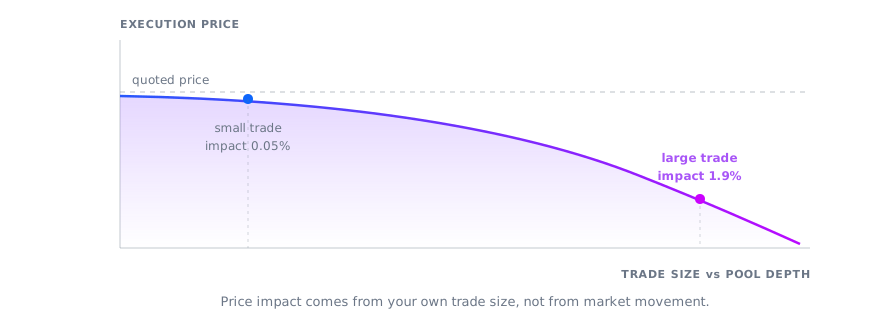
They are related—but completely different.
Price impact is caused by your own trade.
Suppose you’re buying a token from a liquidity pool containing relatively little liquidity.
Your purchase removes a meaningful percentage of the available tokens.
As supply decreases, the automated market maker adjusts the price upward.
In other words:
your order changes the market.
This is price impact.
Unlike slippage, price impact exists even if nobody else is trading.
It is an unavoidable consequence of exchanging large amounts against limited liquidity.
Why Large Trades Experience Higher Price Impact
Section titled “Why Large Trades Experience Higher Price Impact”Imagine two traders buying the same token.
Trader A buys $100.
Trader B buys $100,000.
Trader A barely changes the liquidity pool.
Trader B consumes a significant portion of it.
The second trader naturally receives a worse average execution price because the pool continuously reprices during the transaction.
This is why professional traders rarely send large orders through a single liquidity pool.
Instead, they distribute execution across multiple sources to reduce price impact.
What Does “Minimum Received” Mean?
Section titled “What Does “Minimum Received” Mean?”One of the most important numbers on every swap screen is Minimum Received.
This value represents the smallest amount of tokens you’re willing to accept.
If market conditions worsen beyond that threshold before your transaction confirms, the transaction is cancelled automatically.
Nothing is swapped.
Your assets remain in your wallet.
Think of it as a safety mechanism.
Rather than accepting an unexpectedly poor trade, the blockchain simply refuses to execute it.
This protects traders from dramatic market movements occurring between submission and confirmation.
Understanding Slippage Tolerance
Section titled “Understanding Slippage Tolerance”Most wallets allow users to configure a slippage tolerance.
This is often misunderstood.
Setting slippage tolerance to 1% does not mean you’ll lose 1%.
It means:
I’m willing to accept execution up to 1% worse than the quoted price.
If execution remains within that range, the swap proceeds.
If prices move beyond that limit, the transaction fails.
Choosing the correct setting depends on market conditions.
When Lower Slippage Makes Sense
Section titled “When Lower Slippage Makes Sense”Lower tolerance is generally appropriate for:
- stablecoins
- highly liquid assets
- normal market conditions
- larger trades where execution certainty matters
The downside is that transactions may fail more often during volatile periods.
When Higher Slippage May Be Necessary
Section titled “When Higher Slippage May Be Necessary”Higher tolerance is sometimes required when trading:
- newly launched tokens
- memecoins
- highly volatile assets
- extremely illiquid markets
Without sufficient tolerance, transactions may repeatedly fail because prices move too quickly.
Higher tolerance increases execution probability—but also increases the amount of price movement you’re willing to accept.
Why Chasing Zero Slippage Is a Mistake
Section titled “Why Chasing Zero Slippage Is a Mistake”Many beginners believe zero slippage should always be the goal.
In reality, zero slippage is often impossible.
Markets move continuously.
Even on Solana, where blocks are confirmed extremely quickly, prices continue changing every second.
Professional traders don’t attempt to eliminate slippage entirely.
Instead, they focus on minimizing the total cost of execution.
Sometimes allowing 0.3% slippage results in a much better overall outcome than repeatedly submitting transactions that never execute.
Execution Quality: The Metric Professionals Actually Watch
Section titled “Execution Quality: The Metric Professionals Actually Watch”Retail traders often compare only:
- displayed price
- fees
Professional traders evaluate something broader:
execution quality.
Execution quality combines every factor affecting the final outcome:
- quoted price
- routing quality
- price impact
- slippage
- network fees
- protocol fees
- execution reliability
Ultimately, only one number matters:
How many tokens actually reached your wallet?
Everything else is simply part of achieving that result.
How Aggregators Reduce Hidden Costs
Section titled “How Aggregators Reduce Hidden Costs”Modern DEX aggregators are designed to optimize execution rather than simply display prices.
Instead of routing every trade through one liquidity pool, they evaluate multiple possible paths across the Solana ecosystem.
Depending on market conditions, the routing engine may:
- split orders across several pools
- use multi-hop routing
- avoid shallow liquidity
- select routes with lower price impact
- compare expected outputs before execution
The objective isn’t to eliminate slippage entirely.
It’s to reduce unnecessary execution costs wherever possible.
Reading a Swap Confirmation Like a Professional
Section titled “Reading a Swap Confirmation Like a Professional”Before confirming any transaction, take a moment to review more than just the exchange rate.
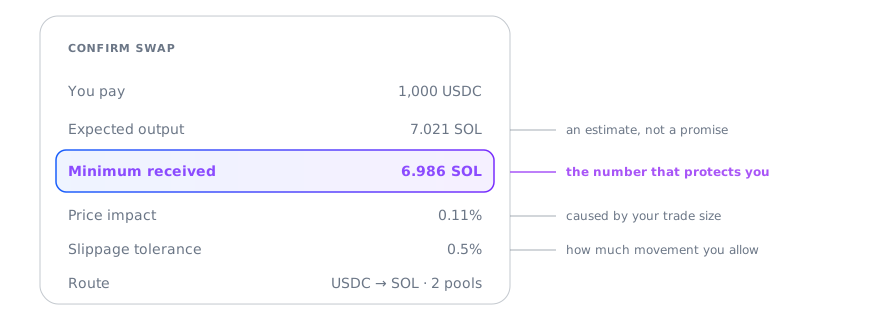
A good habit is to check:
Expected Output
Section titled “Expected Output”How many tokens should you receive?
Minimum Received
Section titled “Minimum Received”What is the worst acceptable outcome?
Price Impact
Section titled “Price Impact”How much is your own order moving the market?
Slippage Setting
Section titled “Slippage Setting”Is your tolerance appropriate for current market conditions?
Routing
Section titled “Routing”Is the trade using multiple liquidity sources?
These values provide a much clearer picture of the transaction than the headline exchange rate alone.
Where Swap.io Fits
Section titled “Where Swap.io Fits”Swap.io is built around helping users achieve better execution rather than simply displaying market prices.
Before a transaction is submitted, the platform evaluates available liquidity across supported Solana venues and determines an efficient execution path based on current conditions.
Rather than focusing on a single metric such as slippage, Swap.io emphasizes the complete trading outcome by combining smart routing, transparent pricing information, and efficient liquidity access.
This allows traders to make more informed decisions before approving a swap while keeping the execution process simple.
Key Takeaways
Section titled “Key Takeaways”- Slippage is the difference between the quoted price and the executed price.
- Price impact is caused by your own order moving the market.
- Minimum Received protects traders from unexpectedly poor execution.
- Slippage tolerance defines the maximum price movement you’re willing to accept before a transaction fails.
- Large trades typically experience greater price impact than smaller ones.
- Professional traders focus on execution quality rather than displayed prices alone.
- Smart routing can reduce hidden execution costs by accessing multiple liquidity sources.
Frequently Asked Questions
Section titled “Frequently Asked Questions”What is slippage in crypto?
Slippage is the difference between the price quoted when you initiate a trade and the price at which it ultimately executes on-chain.
Is slippage always bad?
No. Small amounts of slippage are normal in active markets. The goal is to minimize unnecessary slippage while allowing trades to execute successfully.
What causes price impact?
Price impact occurs when your own trade consumes liquidity from a pool, causing the exchange rate to change during execution.
What does "Minimum Received" mean?
It is the lowest amount of tokens you’re willing to accept. If execution falls below that amount, the transaction is cancelled automatically.
Why do some transactions fail?
Transactions often fail because market prices move beyond your configured slippage tolerance before confirmation.
How can I reduce execution costs?
Use platforms that evaluate multiple liquidity sources, review price impact before confirming, and choose an appropriate slippage tolerance based on market conditions rather than using the same setting for every trade