How DEX Aggregators Find Better Routes on Solana
Most traders think getting the best swap is simple: choose the biggest decentralized exchange, click Swap, and you’re done.
In reality, that’s almost never how professional execution works.
The Solana ecosystem contains dozens of liquidity sources, each with different prices, liquidity depths, fee structures, and market participants. A single token pair can trade simultaneously across Raydium, Orca, Meteora, Phoenix, OpenBook and numerous specialized pools. At any given moment, each venue may offer a slightly different execution price.
For a small trade, these differences may be negligible.
For larger trades - or during volatile markets - they can become the difference between receiving thousands of dollars more or less in value.
This is exactly why DEX aggregators exist.
Instead of asking “Which DEX should I use?”, professional traders ask a different question:
“How can I achieve the best possible execution?”
That subtle difference changes everything.
Why Liquidity Is Fragmented on Solana
Section titled “Why Liquidity Is Fragmented on Solana”Unlike traditional exchanges, decentralized trading isn’t built around one central order book.
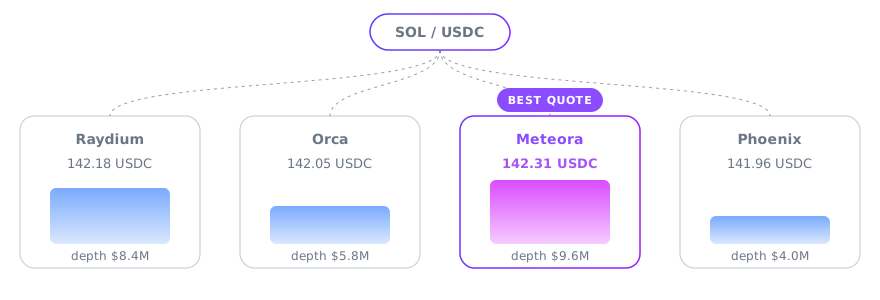
Liquidity is distributed across many independent protocols.
- Each protocol attracts different liquidity providers.
- Each pool has different depths.
- Each pool charges different fees.
- Each pool reacts differently to market movements.
This isn’t a weakness of decentralized finance.
It’s actually one of its strengths.
Competition encourages innovation.
- Some protocols optimize stablecoin trading.
- Others specialize in concentrated liquidity.
- Some focus on new token launches.
- Others prioritize capital efficiency for large trades.
Rather than forcing every trader into one marketplace, Solana allows many specialized markets to compete simultaneously.
The challenge is no longer finding liquidity.
It’s finding the best liquidity.
Why Two People Can Receive Different Prices
Section titled “Why Two People Can Receive Different Prices”Imagine two traders each swapping 50,000 USDC for the same token.
Trader A opens a single decentralized exchange.
The platform routes the entire order through one liquidity pool.
Everything executes successfully - but because the trade consumes a meaningful portion of that pool, the price moves during execution.
Trader B uses an aggregator.
Instead of relying on one pool, the order is divided across multiple venues.
Part of the trade executes through Raydium.
Another portion executes through Orca.
Another finds a cheaper route through an intermediate asset before reaching the final token.
Both traders bought exactly the same asset.
Both traded at almost exactly the same time.
Yet Trader B finishes with more tokens.
Not because they were lucky.
Because the routing was better.
Execution Quality Matters More Than Price
Section titled “Execution Quality Matters More Than Price”Most trading interfaces encourage users to focus on price.
Professional traders focus on execution.
Those are not the same thing.
Execution quality is the total outcome of a transaction after accounting for every hidden cost:
- quoted price
- liquidity depth
- price impact
- routing efficiency
- protocol fees
- network fees
- probability of successful settlement
The cheapest displayed quote is not always the cheapest execution.
In many cases, accepting a slightly longer routing path produces a better overall result than forcing a trade through the shortest available route.
This is why institutional trading systems optimize execution rather than individual prices.
How Smart Order Routing Works
Section titled “How Smart Order Routing Works”A DEX aggregator acts as an execution engine.
Before sending a transaction to the blockchain, it evaluates multiple possible paths.
A simplified process looks like this:
- Scan available liquidity across supported protocols.
- Calculate expected output for every possible route.
- Estimate fees and price impact.
- Compare direct and multi-hop paths.
- Split orders where beneficial.
- Submit the optimal transaction.
All of this happens in fractions of a second.
To the user, it feels like clicking one button.
Behind the scenes, the routing engine may have evaluated hundreds or thousands of possible combinations.
Single-Hop vs Multi-Hop Routing
Section titled “Single-Hop vs Multi-Hop Routing”Many traders assume the shortest path must also be the cheapest.
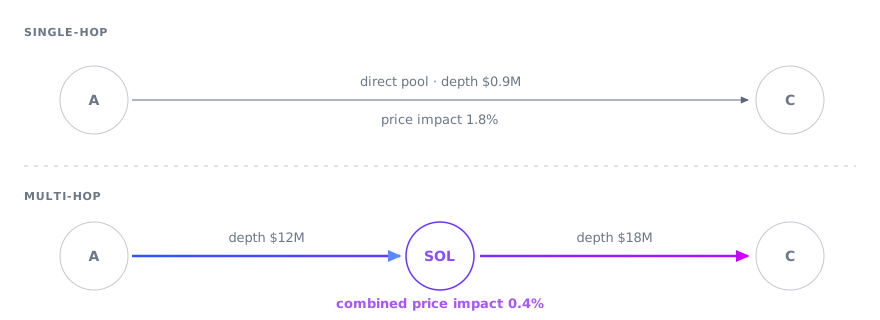
On-chain markets don’t work that way.
Suppose you want to swap Token A for Token C.
There is a direct liquidity pool.
However, that pool is relatively shallow.
The routing engine discovers another possibility:
Token A → SOL → Token C
Although this route involves an additional step, both intermediary pools are much deeper.
The combined price impact becomes significantly lower than using the direct pool.
The transaction becomes longer.
The execution becomes better.
Professional routing engines constantly evaluate these possibilities because the mathematically shortest route is not necessarily the most capital-efficient one.
Why Large Orders Need Different Routing
Section titled “Why Large Orders Need Different Routing”Execution becomes increasingly important as trade size increases.
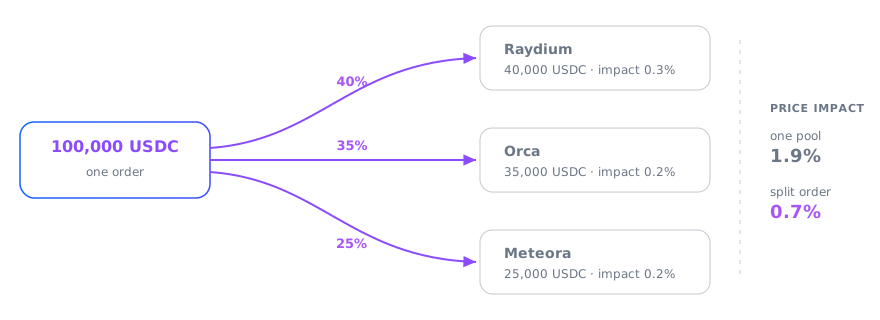
A $100 swap rarely changes market prices.
A $100,000 swap often does.
If the entire order executes through one liquidity pool, that pool’s pricing curve moves against the trader.
This is known as price impact.
One solution is to divide the order.
For example:
- 40% through one pool
- 35% through another
- 25% through a third
Instead of consuming one liquidity source, the trade consumes several simultaneously.
Each individual pool experiences less price impact.
The combined execution improves.
This principle is standard practice in traditional finance and increasingly common across decentralized markets.
Why Aggregators Don’t Replace DEXs
Section titled “Why Aggregators Don’t Replace DEXs”A common misconception is that aggregators compete with decentralized exchanges.
They don’t.
DEXs create liquidity.
Aggregators discover it.
Without exchanges like Raydium, Orca, Meteora or Phoenix, aggregators would have nothing to route through.
Likewise, without aggregation, users would often need to compare multiple exchanges manually before every transaction.
The relationship is complementary.
Liquidity providers build markets.
Aggregators connect traders to those markets efficiently.
What Should You Look for in a DEX Aggregator?
Section titled “What Should You Look for in a DEX Aggregator?”Not every aggregator delivers the same execution quality.
When comparing platforms, experienced traders typically evaluate:
Liquidity Coverage
Section titled “Liquidity Coverage”How many trading venues are included?
Broader coverage generally means more routing options.
Routing Intelligence
Section titled “Routing Intelligence”Can the platform evaluate multi-hop routes and split orders intelligently?
Or does it simply compare a handful of pools?
Transparency
Section titled “Transparency”Can you see:
- expected output
- price impact
- minimum received
- estimated fees
- routing path
before confirming?
Reliability
Section titled “Reliability”Does the platform continue to execute reliably during periods of high volatility?
Execution quality matters most when markets become difficult.
Where Swap.io Fits
Section titled “Where Swap.io Fits”Swap.io is designed around execution rather than exchange selection.
Instead of requiring users to choose a single liquidity source, it searches across supported Solana liquidity venues to identify efficient execution paths based on current market conditions.
Depending on the trade, this may involve:
- selecting a direct route,
- using a multi-hop path,
- splitting the order across multiple pools,
- or combining several approaches to improve overall execution.
The objective is not simply to find the lowest displayed price.
It is to maximize the amount of value ultimately delivered to the user’s wallet.
As Solana’s liquidity ecosystem continues to expand, intelligent routing becomes increasingly important - not because decentralized exchanges are failing, but because decentralized markets are becoming more sophisticated.
Key Takeaways
Section titled “Key Takeaways”- Solana liquidity is distributed across many independent protocols rather than one central exchange.
- Different liquidity pools can produce different execution prices for the same trade.
- DEX aggregators compare multiple routing paths before executing a transaction.
- Smart order routing can reduce price impact by using multi-hop paths or splitting orders across multiple pools.
- Professional traders evaluate execution quality rather than simply choosing a favorite exchange.
- Aggregators complement decentralized exchanges by helping traders access fragmented liquidity more efficiently.
Frequently Asked Questions
Section titled “Frequently Asked Questions”What is a Solana DEX aggregator?
A Solana DEX aggregator is a routing engine that compares available liquidity across multiple decentralized exchanges and selects an efficient execution path for a swap based on current market conditions.
Is a DEX aggregator itself a decentralized exchange?
No. A DEX aggregator typically does not create liquidity. Instead, it connects to existing decentralized exchanges and routes transactions through one or more of them.
Why do different DEXs show different prices?
Liquidity is fragmented across multiple pools. Different pool depths, fees and market activity can produce different prices for the same token pair.
What is multi-hop routing?
Multi-hop routing executes a trade through one or more intermediary tokens - such as SOL or USDC - to access deeper liquidity and improve the final execution price.
Is the shortest route always the cheapest?
No. A longer route through deeper liquidity pools can often produce a better overall outcome than a direct swap through a shallow pool.
When should I use a DEX aggregator?
Aggregators are particularly useful when trading larger amounts, less liquid tokens or during periods of market volatility where execution quality has a greater impact on the final result.